Overview
The postgraduate programmes at the School of Design and Innovation are designed for graduates seeking advanced design knowledge, research capabilities and leadership in creative practice. Through studio-led learning, interdisciplinary inquiry and industry engagement, students deepen their expertise while addressing complex design challenges.

M.Des.
An advanced programme focused on design research, innovation and strategic thinking. Students engage in specialised studios, collaborative projects and practice-led inquiry.
School of Design and Innovation
Master of Design (M.Des.)
Programme Overview
SDI offers three Master’s programmes – User Experience Design, Product Design and Communication Design. All of them are developed as pivot programmes through which the student can adapt and develop their career focus into evolving into a designer. At the same time, these programmes support students to specialise further in the same field if the student is already a user experience, or product, or communication designer. The curriculum provides for this double engagement for students depending upon their learning background and levels, through offering studio pathways, advanced university and school electives.
These programmes enable students to identify significant contemporary problems, inculcate critical thinking, critique conventional solutions, and challenge the status-quo in order to provide fresh ideas and solutions through team collaboration. There are dedicated studio spaces where students acquire key skills and explore new design theories and processes in order to ignite new ideas to complex problems in a holistic manner. The programmes are developed in consultation with high level industry experts and will be enriched through industry master classes and specialised inputs in studio. The final/ capstone semester can be taken as a self-directed design capstone or capstone in an internship format, all of which would deepen the knowledge, skills and experience of the student making them ready to make interventions as researcher, practitioner, and/or academic. These programmes are also designed for entrepreneurship and transdisciplinary mindset.
Specialisations



M.Des. Product
Career Options after M.Des.
Graduates of our Masters Programmes can find jobs in the following interrelated fields. These include but are not limited to the following roles.
- Design Researcher
- Design Manager
- Design Strategist
- User Experience Designer
- User Researcher
- New Media Designer
- Graphic Designer
- Brand Designer
- Animation Designer
- Editorial Designer
- Photographer
- Illustrator
- Brand Manager
- Campaign Designer
- Content Designer
- Exhibition Curator
- Type Designer
- Information Architect
- Information Visualizer
- Interaction Designer
- Interface Designer
- Visual Designer
- Front-End / UI Developer
- Design Consultant
- Design Educator
Why M.Des. at RV University?
- Highly qualified Faculty with tremendous academic and industry experience having qualifications from some of the best Design Schools of the world including NID, IDC (IIT Bombay) etc.
- High quality, affordable global design education
- World class infrastructure of studios, workshops, labs, prototyping and incubation facility
- Design pedagogy that facilitates integrative learning through a multidisciplinary process
- Experiential learning through short and long internships, programmes to discover & explore yourself, your neighbourhood and your country
- Self-assessment, where students assess their own work first and only then it is assessed by juries and expert faculty
- International collaborations, master classes
- Experienced and practicing faculty with excellent track record
- Incubation center through which students gain hands-on experience in innovation and entrepreneurship while being nurtured and encouraged by faculty and industry experts
- Locational advantage of studying in Bengaluru which is regarded as the Silicon Valley of India High quality, affordable global education and considered as one of the ‘Next Decade’s Fastest – Growing Cities’ by Forbes Magazine
Eligibility & Selection Criteria
| Programme | National Eligibility test / State Eligibility test if any | Eligibility | Selection Process |
|---|---|---|---|
| M. Design | CEED |
10 + 2 + 3 year Degree in any relevant stream (Applicable only for M.Des. in Communication Design) |
Selection Mode B : Evaluation by interview panel of 2 Reviewers; Interview – Max marks 10, Min marks 5 & Portfolio Review – Max marks 10, Min marks 5 |
How To Apply

Complete Online Application
Select the course and fill out the application form. Apply online https://admissions.rvu.edu.in/

RVU Selection Process
Complete the course-based selection process

Selection Letter Issued
Subject to fulfillment of eligibility and admission process

Programme Registration
On receipt of registration fee as specified in the selection letter

Provisional Admission Letter
Issued upon completion of the selection process
Why Choose the School of Design and Innovation at RVU?
At the School of Design and Innovation, creativity is more than an art, it’s a way of thinking, solving and leading. Our programmes are built to equip you with the mindset, skills and experiences needed to create meaningful, impactful design in a rapidly changing world.
Design Education with Real-World Relevance
We merge creative exploration with industry-aligned skills, ensuring your designs are not only imaginative but also impactful and ready for real-world application.
An Interdisciplinary Canvas
Our flexible curriculum allows you to pair your design studies with minors from Business, Liberal Arts, Law, Economics or Computer Science—broadening your perspective and amplifying your creative impact.
A Collaborative Creative Community
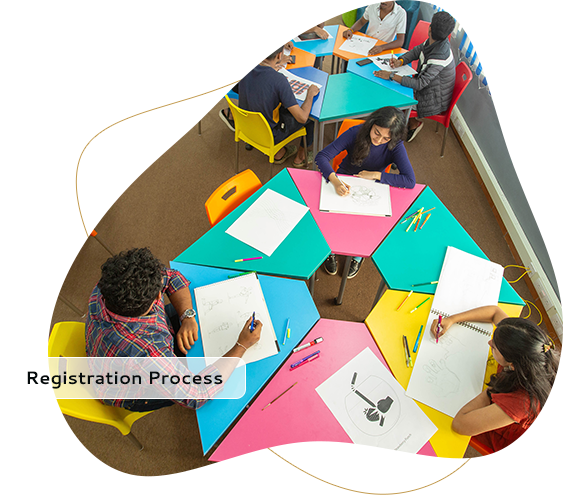
Studios, workshops and critiques create an environment where students learn from one another, challenge conventions and build strong professional networks.
Global and Industry Connections
From live projects with leading companies to exchange programmes with design schools abroad, you’ll gain exposure that prepares you for a career with global relevance.

Learning Outcomes
- Apply design thinking and creative problem-solving to address complex challenges through research, ideation and prototyping.
- Integrate industry practices and tools by working on real-world briefs, studio projects and collaborative assignments.
- Demonstrate technical and creative proficiency across design processes using contemporary digital tools, materials and technologies.
- Engage with global and interdisciplinary perspectives, drawing inspiration from diverse cultures, contexts and design traditions.
- Practice responsible and socially conscious design, guided by principles of sustainability, ethics and inclusivity in professional work.
 Academics
 Admissions
 Faculty
 Enquire